Tuesday, September 16, 2008

Blueberries

Photobucket

This ACEO is done in watercolors on 140# paper.

Blueberry Muffins

I think blueberries are just about the perfect fruit. And one of the best things I got from my years of living in Massachusetts was the recipe for blueberry muffins. While Maine is famous for its blueberries, the best muffin recipe came from the venerable Jordan Marsh department store. I wasn’t a bit surprised to find that my new neighbors in Ohio also had the recipe from their time spent back East in Rhode Island. Even the famed food critic Martin Burros wrote of the famous muffin and the debate over its superiority in the NY Times. Do NOT substitute anything for real butter!

JORDAN MARSH'S BLUEBERRY MUFFINS

1/2 cup butter
1 1/4 cups sugar, plus 3 teaspoons
2 eggs
2 cups flour
1/2 teaspoon salt, optional
2 teaspoons baking powder
1/2 cup milk
2 cups blueberries, washed, drained and picked over
3 teaspoons sugar

1. Cream the butter and 1 1/4 cups sugar until light.

2. Add the eggs, one at a time, beating well after each addition.

3. Sift together the flour, salt and baking powder, and add to the creamed mixture alternately with the milk.

4. Crush 1/2 cup blueberries with a fork, and mix into the batter. Fold in the remaining whole berries.

5. Grease 12 large muffin cups, and fill with batter. Sprinkle the 3 teaspoons sugar over the tops of the muffins, and bake at 375 degrees 30 minutes.

6. Cool 30 minutes before removing. Store, uncovered, or the muffins will be too moist the second day, if they last that long.

Yield: 12 muffins.

Thursday, September 11, 2008

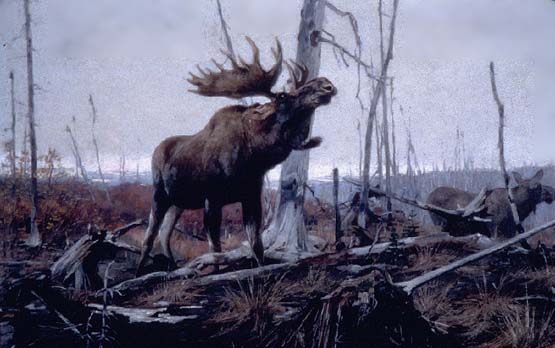
Call of the Wild

To many Europeans of the late 19th century, America represented a land of plenty with boundless opportunities for hunting, an image fueled by popular "Wild West" novels. The first edition of Karl May’s “Winnetou” trilogy appeared in 1893 – books that were soon to make him the most widely read German author ever. Many of his books are written as first-person accounts by the narrator-protagonist, and he sometimes claimed that he actually experienced the events he described. However these stories were written by May while he was in prison. Before writing his tales of the "Wild West," he had never seen the US. His resources included travel accounts,maps, guide books and his own imagination. He made a brief visit to America shortly before his death, but he never saw the western United States he had written about. Buffalo NY was as far West as her went.

I wonder if he had the opportunity to meet Carl Rungius?


Rungius at the easel in a 1950 photograph

Rungius was born in Germany in 1869. From an early age, he was determined to become an artist. Following the German passion for all things Western, Rungius jumped at the chance to visit an uncle in the United States, and he immigrated to the United States in 1896.

Rungius is important in the art world today because he was an innovator - the first career wildlife artist in America. He situated animals in their natural environment, a practice that was new to painting in early twentieth century North America. If he was lucky, back then, he got $25 apiece for them. Like Karl May, his works played an important role in the creation and popularity of the mythic American West, artfully blending history and fiction.

I am so impressed with his use of light and shadow; in both his animal studies and his landscapes, he always executed perfect compositions. I have used his example in painting the ACEO of the wildlife below:


Frederic Remington attended the first major one-man exhibition of Rungius's work in 1908, at the Salmagundi Club in New York City, and afterwards sent him a letter extolling their mutual involvement in depicting rapidly disappearing aspects of American life.

Rungius's ability to accurately depict a number of species secured him a commission to supply the New York Zoological Society with a contract to document threatened species. These paintings, done between1914 and 1934, were collectively entitled the Gallery of Wild Animals and hung in the administration building of the zoological society. The society specifically requested that in doing these paintings Rungius abandon his more impressionistic mature style in favor of his earlier, more precise renderings of animals, as the society wished to maintain scientific exactness in the depiction of threatened species. To this Rungius somewhat reluctantly agreed.

Carl Rungius died in 1959.

Prints of Rungius’s work are available here http://store.encore-editions.com/Gifts/rungius.html

Photos of Carl Rungius and his travels are available at the Glenbow museum http://www.glenbow.org/collections/search/findingAids/archhtm/rungius.cfm


Wednesday, September 10, 2008

Sailing Away


I thought I would do two more sailboats before the season is totally over. Both are ACEOs.

Monday, September 8, 2008

Roses: Pink or Yellow


Both of these paintings are ACEOs, painted in Acrylic

Its funny, neither painting started out with the idea to grow up into a still life of roses. It just sort of happened. I read a quote by Richard Schmidt that sums it up:

"There are times when I have started a work with an end in mind, but then, for one reason or another, as my picture unfolded, it emphatically suggested another direction... I always accept the risk and go for it. I'm convinced that at such times my painting is wiser than I am." (Richard Schmid)

Sunday, September 7, 2008

Haystacks

Post Monet, theres not much more to be done with haystacks in the world of art. But they are great subjects with all those ingrain (no pun intended) colors and textures. Coming from the city I dont know why they are stacked differently but I love the variety of shapes.
I saw these in central Ohio

as were these, which I think were on an Amish farm and bundled by hand: and these which were inspired by an old painting:

Wednesday, September 3, 2008

Land and Sea


In these ACEOs I used a limited palette and simple design to emphasize the drama of the scene.

Tuesday, September 2, 2008

Stonehenge

Stonehenge - a 4x6" acrylic painting of the ring
Stonehenge
An ACEO done in watercolor

I loved visiting Stonehenge and it remains one of my favorite subjects to paint. I found the atmosphere of the place to be enchanting but I never got too caught up in the mystery of how the slabs were moved.
I recently came across this video on Youtube of a gentleman in Michigan who seems to have solved the mystery.